Why retail shouldn't wait for ChatGPT ads to get good
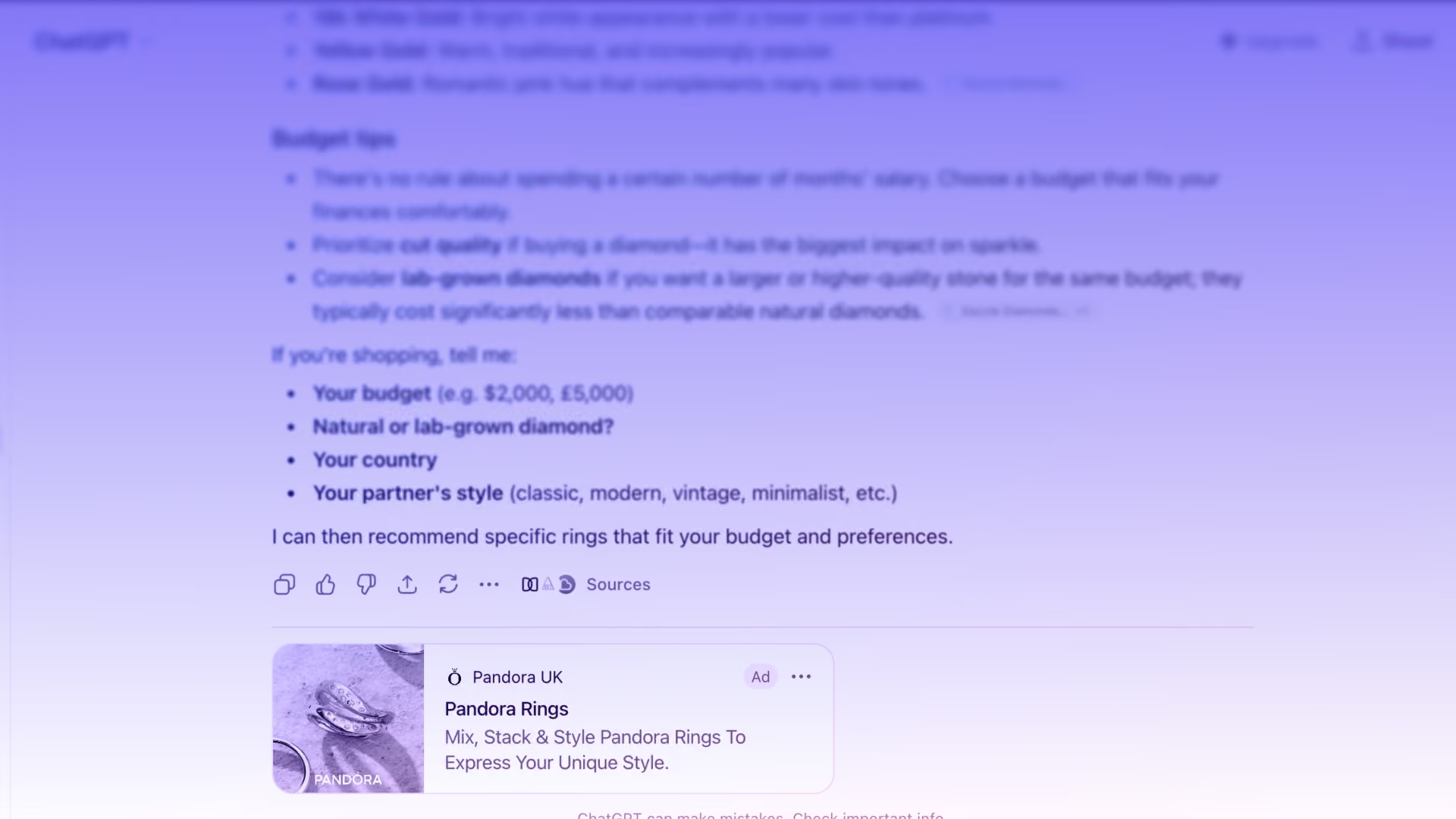
The day before I sat down to write this, ChatGPT ads could only optimise a campaign toward clicks or reach. There was no way to even tell the platform "optimise for a sale." On Friday evening, this changed: OpenAI added a Conversions objective, letting advertisers bid toward the click most likely to convert while still paying per click. It's part of a rapid, ongoing sequence of changes to this platform. If, like me, you are too youthful to remember what the early era of Google Ads felt like, this is probably the closest thing we’ll get.
We've run a short test campaign inside ChatGPT for the past couple of weeks. It's a very small, early sample, brand-awareness spend rather than anything optimised for conversions, but the rough numbers are worth sharing: CPCs landing around £3.20, CPM around £42. Treat that as directional, not definitive. That is precisely where a contained test can work as brand R&D: a controlled investment in measurement infrastructure, audience insight and practical platform fluency before the UK auction becomes genuinely competitive.
Retailers should question the cost of waiting, not just the cost of testing
This entire platform has been built with retail advertising in mind.
Every new ad platform eventually finds its category. ChatGPT ads found retail almost immediately. The first ad unit OpenAI shipped was not a text ad, it was a shopping product card; brand logo, price, stock status, delivery estimate, sitting directly under any answer that looked like a shopping question. Best Buy and Lowe's were among the earliest named advertisers in the USA. When OpenAI picked its first markets outside North America, Zalando, Europe's largest online fashion platform, was named as one of the earliest participants in the UK launch.
Retail isn’t simply another category for ChatGPT ads; it is the format’s first real proving ground.
The most rigorous independent research I've found on actual ecommerce outcomes, a study of 973 sites and $20bn in revenue by researchers at the University of Hamburg and Frankfurt School of Finance & Management, found ChatGPT referral traffic currently converts worse than organic and paid search, but better than paid social. Separately, a 2026 US consumer trust study found that 86% of people who use AI to research a product still verify it somewhere else before buying (Product.ai, 2026 Trust in AI Commerce Report). Translation: this is upper-funnel media right now, visibility and consideration, not last-click sales. If a client needs this quarter's ROAS to justify the spend, this isn't that pitch yet. If they can accept building a position in a channel before it's provable, that's a different, better conversation.
The platform is changing faster than most media plans can track
Lay the timeline out and it's extraordinarily fast for an ad platform:
- 9 Feb 2026 — US launch. Invite-only, roughly $200,000 to $250,000 minimum spend, CPM only.
- 26 Mar — Canada, Australia and New Zealand added.
- 5 May — Self-serve Ads Manager opens to all US businesses, drops the enterprise level spend. CPC bidding, daily budgets and geo-targeting arrive.
- 6 Jun — UK goes live as OpenAI's first European market.
- Early June onward — conversion-tracking infrastructure, a pixel and a Conversions API, starts rolling out.
- 24 Jul — a genuine Conversions bidding objective arrives, alongside improved attribution matching, mobile measurement integrations and bulk campaign tools.
That's a lot of structural change in five and a half months. Google and Meta took years to build out equivalent bidding and measurement infrastructure on their own platforms.
And the ad unit itself still looks unfinished
Creatively, this is extremely basic - design teams will not be impressed. There is no flexible creative canvas, no asset carousel, no headline testing. You're filling fixed fields, a name, a price, an image, a line of copy, into a templated card. Anyone used to Google's or Meta's testing tools will find this restrictive.
ChatGPT has reinvented product discovery, but not yet the product ad.
However, OpenAI is visibly reacting to advertiser pressure already. In the past few weeks, ChatGPT has been spotted showing two ads at the bottom of a single response, where every prior sighting showed exactly one. Whatever the reason for the test, it suggests OpenAI is already experimenting with ad density. Creative flexibility now looks like one of the next obvious constraints to address.
What this means practically
Do not move budget out of proven channels for this. Treat a contained, managed test as your brand R&D: cheap relative to the account history, creative learnings and platform fluency it buys before the format matures and the UK auction gets genuinely competitive. The UK self-serve Ads Manager has existed for a matter of weeks. Almost nobody running retail media in this market has real hands-on experience with it yet, but here lies the advantage: the advertisers running it now will have far more of a head start than their competitors as to how their audiences behave / convert across agentic AI.
If you’re weighing whether retail clients should test ChatGPT ads now, separate the decision into two questions. Is the platform ready to prove ROI? Probably not. Is it worth building real in-market experience before it is? For me, unequivocally, yes.

Why being named one of the UK’s Best Workplaces™ matters to our clients, not just our people
Why retail shouldn't wait for ChatGPT ads to get good